
Index Cards
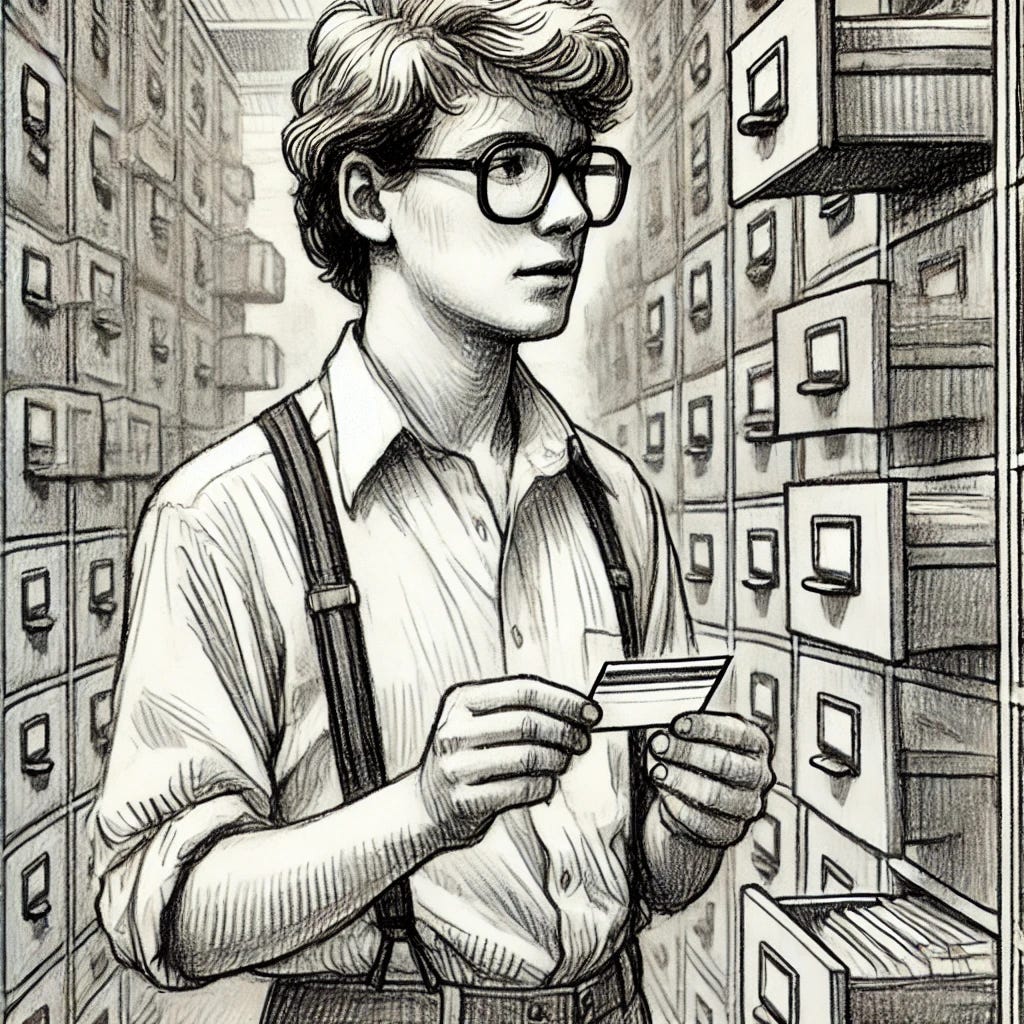
The magazine was an empire built on index cards.
Let me explain.
When I was promoted from being an assistant, I started a new position as an editor and writer in Goings On About Town. (The small type at the front of the magazine.) I was replacing a lovely older woman who was retiring after forty-three years on the job. When she first started working at the magazine, she would wear long white gloves to work. She showed me a filing cabinet that was filled with index cards. On each one, she had typed the name of a movie and its release date: “The Graduate” (Mike Nichols) 12/21/67 (Coronet, Lincoln & 57th).
It took me a second before I realized that this filing cabinet represented an amazing database: every movie that had opened in New York in the past half-century. If Pauline Kael or one of the other critics had reviewed the movie, the blurb was typed on the card, often with handwritten corrections.
Sadly, I was the post-typewriter generation and this tradition died with me.
Once you started looking around, the index cards were everywhere. The magazine had two proper librarians who would make index cards for every assignment, every Talk story. Writers had their own index cards—some of them full of publication dates, some of them with just a few dates and then dwindling off into white space.
I read a memoir in which the writer described how William Shawn would plot out the forthcoming issues by rearranging index cards on a large board. If a planned Profile were to become suddenly newsworthy—say, a scientist whom a reporter was tracking won a Nobel prize—the piece would be rescheduled further into the future, lest there be any indication that the magazine was capitalizing on the attention. To invoke another phrase heard around the place: this Mr. Shawn story is “too good to check.”
The magazine moved offices twice during my time, and I remember coming upon a filing cabinet that was filled with index cards of “Anecdotes.” These were stories submitted by the staff: overheard remarks in the street or funny encounters that might appear these days in the Metropolitan Diary in the Times. I suppose they were used to fill out the “Notes & Comment” section when little items were needed. Still, how cool. A collection of observations that capture a vanished vernacular, snapshots of a bygone city.
I suppose I bring all this up because the index cards represent a different way of thinking about a magazine. The most common way, perhaps, is to remember the big pieces, the Silent Springs and the David Granns. But a magazine is also a way of encoding a sensibility. The index cards were a beautiful system of information capture. All the ideas, the observations, the finished work that flowed through this group of people in this place and in this time. So simple, so elegant.