
The Silence
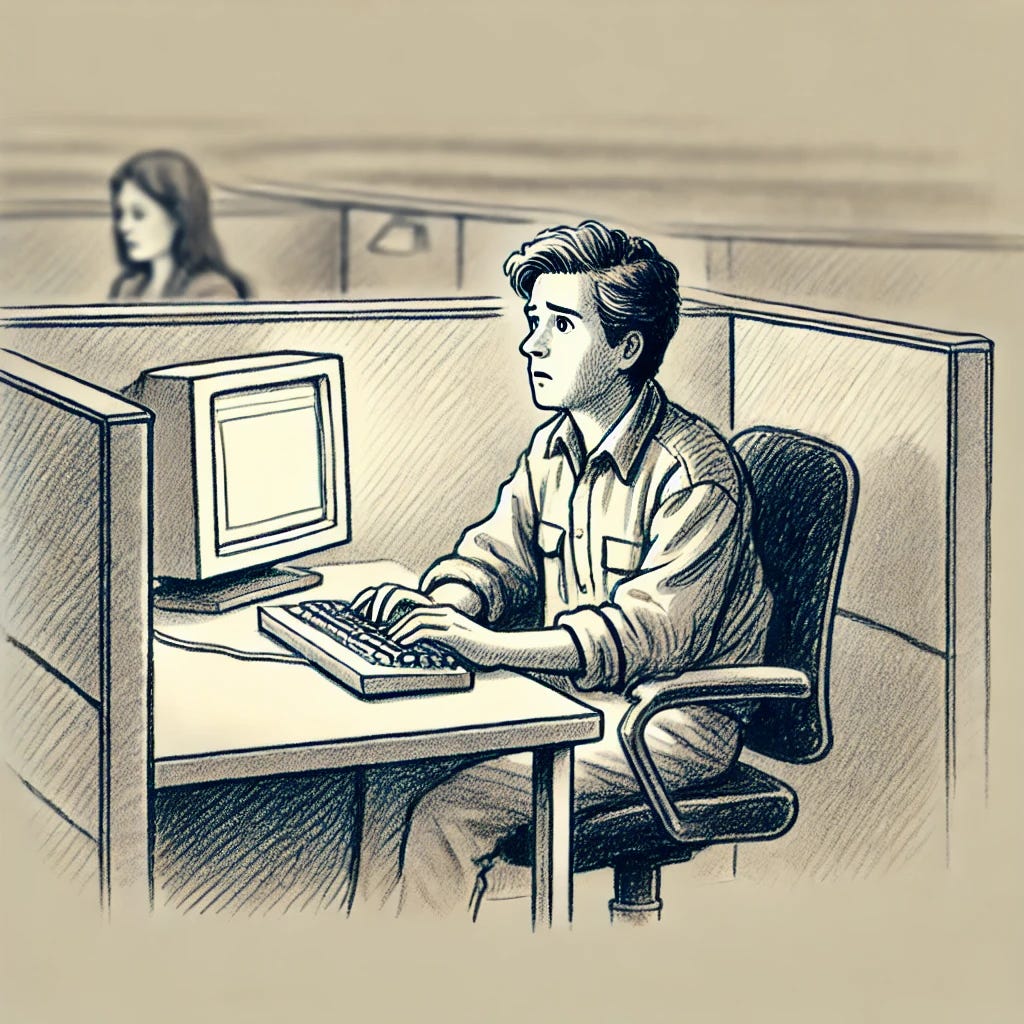
When I first started in magazines, the office was often quite loud, bustling. There were still typewriters, which provided a kind of backbeat, and people moving to and through, circulating faxes, memos, and marked-up manuscripts. The mail was a big event, twice daily, and I would talk to the mail dudes (the mailroom guy seemed to only hire handsome young dudes) about movies, sports, and whatever other thing.
In this way, the office was a theatre. Writers would come in for meetings with the editor-in-chief and they had to walk through a wide central space that we all looked out upon. I remember when Updike stopped by, dressed as if going to church in New England. He spoke in beautiful, mellifluous sentences—just like his prose—and seemed to find the place more “masculine” than when he was last there. (Please do read Nicholson Baker’s U and I, a book-length riff on being both frustrated and awed by Updike’s preternatural eloquence.) There was still a generation of writers and artists who lived in their nooks around the world—Nova Scotia, Jamaica. Coming to the city was an event, a pilgrimage. Sitting in your chair, you felt like you were working near a coral reef, an edge place where interesting things happened.
There was a type of person you don’t see as much anymore: the maestro of the office. They would drop from desk to desk, offering jokes and stories, a welcome presence. They were also important sources of gossip. Whole afternoons, whole careers, could be spent this way. (Whole careers could also be wasted this way.) The magazine where I worked also had a floor of writer’s offices, each room somehow a picture of the writer’s psyche. The shelf lined with hardback copies of a new book for the writer on the upswing. The sandwich wrappers, ashtrays, and crumpled pencils of the blocked or thwarted. People liked being at the office, for the most part. It was a clubhouse with free stationery.
Then, over the years, the silence descended. Electronic communication lead to much less paper moving about—no more trips to the copy machine and having chats—and much less human traffic. The editing of manuscripts moved largely to Microsoft Word and e-mail. I learned a lot about editing by carrying around page proofs, looking at the pencil marks of deletions, insertions, and reshapings. (I also learned how not to edit; one editor would cross out the writer’s first paragraph, without fail, as a show of authority.) Everyone became a little more locked in to their machines. One junior editor would sit perched behind the desk of his mentor, watching the keystrokes. In retrospect, a great idea that I wish I’d copied.
The offices also got smaller and less private. To talk to someone at their cubicle was to be too much on stage. You felt like you were potentially annoying seven other people who were just trying to get work done and did not want to hear your opinion on the new Noah F-ing Baumbach, thank you very much. Sure, you could step away for coffees or a lunch, but the easy collegiality of the office faded. Everybody was working hard. Everyone was busy. We we were all a little cramped, a little less friendly, and unable to embrace the moment and the sense of occasion. At least I was.
It’s not just the office that grew silent. When I walk through New York City, I remember the great bookstores (Gotham Book Mart), music stores (Other Music), and the stacks of free weeklies (New York Press)—and I feel a cultural silence. You hate to wallow in nostalgia but the city once had greater texture, more objects, more to look at and to hold. So, lately, one thing that I’ve been trying to do is what I call fighting the silence. I purchase physical books. I force myself to go to concerts, to readings, and do more meeting and talking and lingering. It’s hard to do though, surprisingly hard. I am trying to develop the muscle again. ◊